Financial Planning, Wealth Management
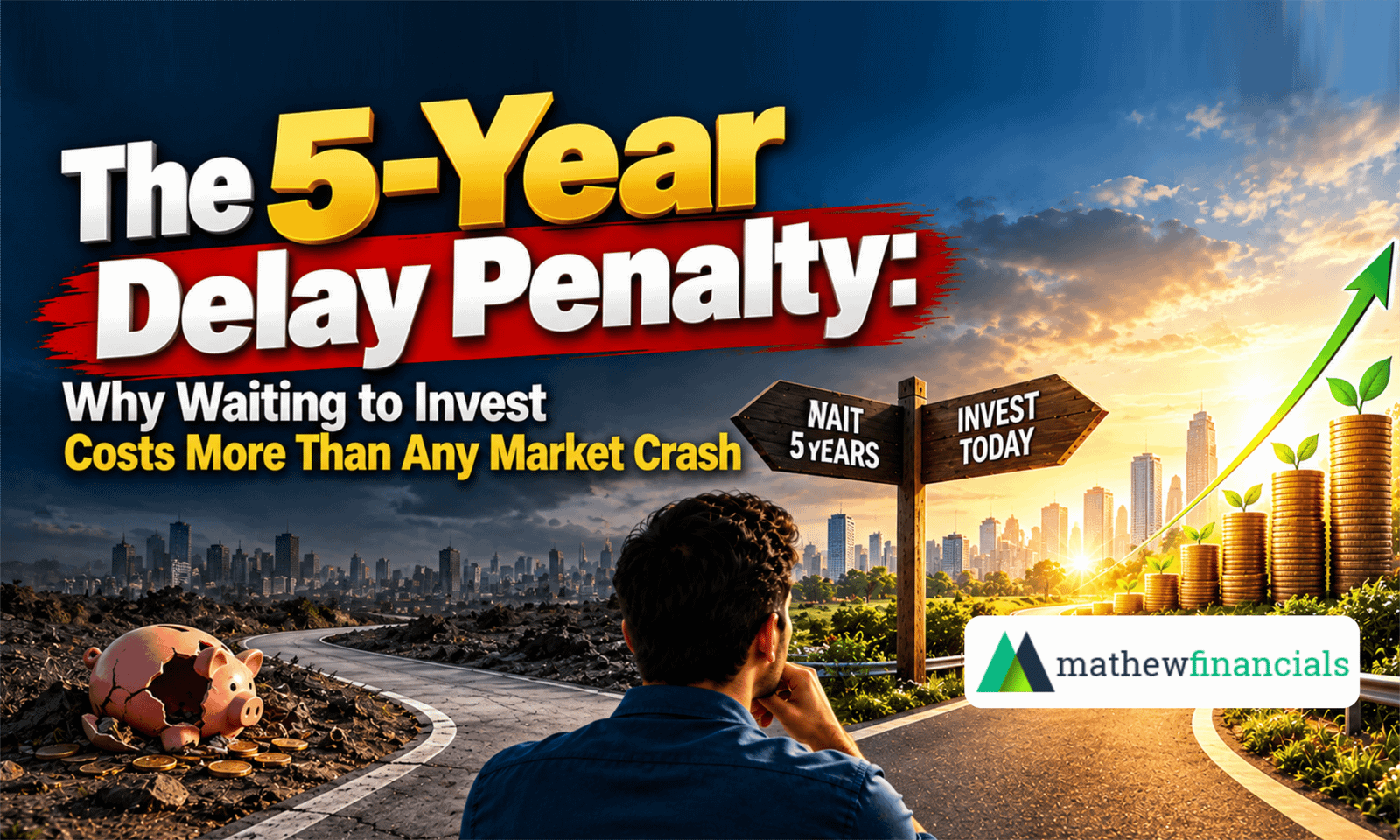
The 5-Year Delay Penalty: Why Waiting to Invest Costs More Than Any Market Crash
“I'll start investing once my appraisal comes through in July.”
“I'll wait until after Diwali when expenses settle down.”
“The market feels too high right now. I'm waiting for a crash to enter.”
If you've said any of these things in the last few years, you're not alone.
Waiting for the “right moment” can feel like a responsible and cautious decision. But when it comes to long-term investing, waiting too long can come at a significant opportunity cost.
While investors often worry about market crashes, another risk deserves attention: the cost of losing valuable time in the market and missing out on the potential benefits of compounding.
The ₹1.64 Crore Math Problem
To understand what delaying an investment can cost, let's look at a simple example.
Imagine two friends, Rohan and Vikram, who both decide to start a monthly Systematic Investment Plan (SIP) of ₹10,000.
For illustration, assume an annualized return of 12% over the investment period. This is only a hypothetical calculation; actual market returns can be significantly different.
Rohan starts investing at age 25. He invests ₹10,000 every month for 30 years, until he turns 55.
Total amount invested: ₹36 lakh
Illustrative value at age 55: approximately ₹3.53 crore
Vikram waits until age 30 to start. He invests the same ₹10,000 every month for 25 years, until he turns 55.
Total amount invested: ₹30 lakh
Illustrative value at age 55: approximately ₹1.89 crore
The difference in their contributions is only ₹6 lakh.
However, under this hypothetical 12% return assumption, the difference in their final portfolio values is approximately ₹1.64 crore.
The important lesson isn't that an investor can expect a 12% return every year.
The lesson is the value of time.
Rohan didn't invest more every month. He simply started five years earlier.
Those additional years gave his investments more time to potentially generate returns, and those returns had more time to compound.
This is why delaying investment can have a much larger impact than many investors initially realize.
Savings Accounts and the Cost of Idle Cash
What happens to your money while you're waiting for the “perfect time” to invest?
Keeping money in a savings account can be appropriate for short-term needs and emergency funds. However, keeping long-term investment money entirely in low-return instruments can create another challenge: purchasing power.
If inflation rises faster than the return earned on your money, the amount may grow in rupee terms while its purchasing power grows much more slowly.
For example, if an investment earns 3% while inflation averages 6%, the investor is experiencing negative real growth before considering taxes.
This doesn't mean investors should avoid savings accounts.
It means different types of money should have different purposes.
Money needed for emergencies and short-term expenses may need safety and liquidity.
Money intended for long-term goals may require a different investment strategy based on the investor's time horizon, risk tolerance, and financial objectives.
The "Lifestyle Creep" Illusion
Another common reason people postpone investing is the belief that they will have more money available next year.
But when income increases, expenses often increase as well.
A salary hike can quickly be absorbed by:
• A better phone
• More frequent dining out
• Higher rent
• Lifestyle upgrades
• New subscriptions
• Bigger purchases and EMIs
This is commonly referred to as lifestyle creep.
You don't necessarily find extra money to invest simply because your salary increases.
You need to create a system that allows your investments to increase alongside your income.
One practical approach is to increase your SIP whenever your income increases.
For example, if your salary increases by 10%, you could consider increasing your monthly SIP by a portion of that increase rather than allowing the entire amount to disappear into additional spending.
Why Trying to Time the Market Can Be Difficult
Waiting for a market correction may sound logical.
You might think:
“I'll invest when the market falls.”
But the problem is that nobody knows in advance when the next correction will happen, how deep it will be, or when the recovery will begin.
Investors can also experience two different emotional challenges.
When markets are rising, prices may feel too expensive and investors may keep waiting for a correction.
When markets fall, fear and uncertainty can make investors even more hesitant to invest.
This can create a cycle where an investor keeps waiting for a “better” entry point but never actually starts.
An SIP provides a systematic approach to investing. It allows investors to invest a fixed amount at regular intervals, purchasing more units when prices are lower and fewer units when prices are higher.
An SIP does not eliminate market risk or guarantee returns.
Its key advantage is that it reduces the need to make a large investment decision based entirely on market timing.
Bridging the Gap Between Intention and Execution
Most people understand that they should invest for their long-term goals.
The bigger challenge is often converting that intention into a consistent financial plan.
Working with an AMFI Registered Mutual Fund Distributor can help investors structure their mutual fund investments around their goals, investment horizon, risk profile, and financial responsibilities.
Instead of constantly wondering which investment to choose or whether the market is at the “right” level, investors can follow a defined investment strategy and review it periodically.
For investors looking for a Mutual Fund Distributor in Indore, having accessible professional guidance can also make it easier to review investments, adjust SIPs as income changes, and stay disciplined during periods of market volatility.
The objective is not to predict every market movement.
It is to create a process that keeps long-term financial goals on track.
Start With a Plan, Not With Market Predictions
There is no guaranteed way to identify the perfect day to invest.
Markets can rise after you invest, fall shortly afterward, or move sideways for extended periods.
What investors can control is how much they invest, how consistently they invest, how long they stay invested, and whether their portfolio remains aligned with their financial goals.
Starting earlier can give compounding more time to work.
Increasing investments as income grows can help accelerate wealth creation.
And maintaining discipline during market volatility can help prevent emotional decisions.
Don't Let Waiting Become Your Investment Strategy
The cost of investing is visible.
The cost of waiting is often invisible.
Every year you postpone a long-term investment is another year in which your money does not get the opportunity to participate in potential market growth and compounding.
That doesn't mean you should invest without considering your financial situation.
Build an emergency fund, manage high-cost debt, understand your goals, assess your risk tolerance, and then create a long-term investment strategy appropriate for your circumstances.
The goal isn't to find the perfect time.
The goal is to stop postponing the financial decisions that matter.
Ready to Build a Structured Investment Plan?
At Mathew Finserv, we help investors create structured investment strategies based on their financial goals, risk profile, investment horizon, and changing income.
If you're looking for an AMFI Registered Mutual Fund Distributor or a Mutual Fund Distributor in Indore, professional guidance can help you bring greater structure and discipline to your long-term investment journey.
Call / WhatsApp: 9302140189
Website: mathewfinancials.com